Mars Transporter and Deep Space Habitat will launch in 2020s
4 || risingbd.com
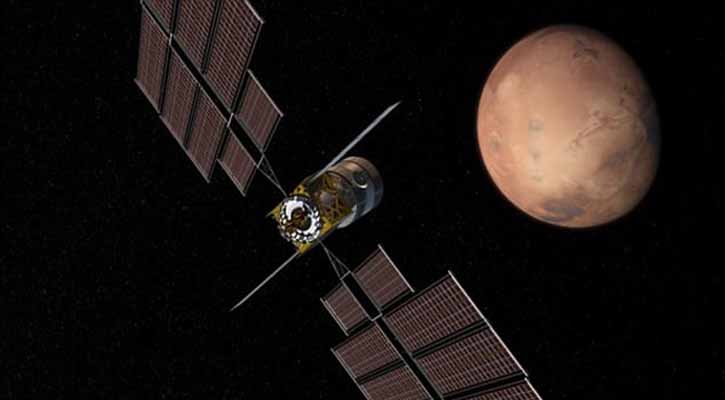
Risingbd Desk: A new generation of space stations which will allow humanity to reach out further into the universe could become a reality within the next three years.
The first base - known as the Deep Space Gateway - will orbit between Earth and the moon and is expected to launch as early as 2020.
The habitat will support critical research and open up opportunities for future exploration of deep space, as well as a return to the moon and missions to Mars.
NASA has teamed up with six companies to develop deep space vehicles as part of its NextSTEP program.
And Boeing has now revealed its vision for the habitat and space vehicle that will allow astronauts to journey to Mars.
The Seattle-based aerospace firm's Deep Space Gateway will be launched using Nasa's Space Launch System (SLS).
The SLS is currently being put through its paces, in anticipation of its first mission in November 2018.
Mr Pete McGrath, director of global sales and marketing for Boeing's space exploration division, said: 'The ability to simultaneously launch humans and cargo on SLS would allow us to assemble the gateway in four launches in the early 2020s.'
The Gateway will use a system similar to the one which allows commercial vehicles to dock with the International Space Station.
This would allow the Deep Space Transport vehicle - which will take humans to Mars - to dock with the Gateway.
Once near Mars, crews could deploy a lander for surface missions. It can also conduct other scientific and robotic missions while in orbit.
The transport vehicle would be equipped with accommodation specifically designed to protect passengers from deep space's harsh environment.
The Gateway itself will be powered by a Solar Electric Propulsion (SEP) system, a new technology developed by Nasa.
SEP is powered by solar arrays and uses ten times less energy than conventional rocket.
It has already been proven on the Dawn spacecraft - launched by Nasa in September 2007 to study two proto-planets in the asteroid belt found between Mars and Jupiter.
Nasa hopes that the SEP will be used to power future missions within our solar system, including Mars.
Source: The Mail
Risingbd/April 5, 2017/Mukul
risingbd.com