Will Nafis be pardoned as happened to McCord?
Staff Correspondent || risingbd.com
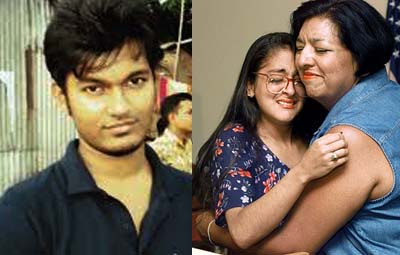
Quazi Nafis (left), Eliadah McCord (Wearing eyeglasses)
SYED ZAHIRUL ABEDIN, DHAKA, AUG 10: Though the nature of crimes in two incidents is not the same, there are many similarities between them.
One case is about Bangladeshi student Quazi Mohammad Rezwanul Ahsan Nafis and the other is about American woman Eliadah McCord. Nafis was sentenced 30-year in jail by a US court on charge of blowing up the Federal Reserve Building (though fake) on Friday, while the second was sentenced by a court in Dhaka on charge of smuggling seven pounds of heroin taped to her body into Bangladesh back in 1992.
Perhaps, people of Bangladesh can still remember about the case of Eliadah McCord of Houston, Texas. McCord was arrested at the Dhaka International Airport in 1992 after she was caught trying to smuggle seven pounds of heroin taped to her body. Finally, she was sentenced to life imprisonment in Bangladesh. At that time, she was only 18-year-old.
Bangladeshi law calls for either life imprisonment or death by hanging for those who are found with more than 25 grams of heroin. However, a Dhaka court sentenced McCord life imprisonment. Later, she made an appeal against her verdict to the Supreme Court which was also turned down. After passing four years and six months in Dhaka Central Jail, McCord was pardoned by the then President at the request of influential US Congressman Bill Richardson in 1996. Richardson, also a former US ambassador to the United Nations and former US Energy Secretary, came to Dhaka and took McCord back with him to the United States on July 30, 1996. The US Congressman also expressed his gratitude after meeting with the then Prime Minister Sheikh Hasina for responding to the request of releasing McCord.
After a day in Washington D.C., McCord returned to Houston with her mother on August 1, 1996. McCord earned an associate degree (June 1999) and bachelor`s degree (June 2001) within five years of returning to the US. She also worked full-time at NASA`s Johnson Space Center in Houston and, more recently, at the AES Corporation. She now lives and works on the East Coast. During the interview on the National Geographic episode, McCord said she learned a lot and would never do it again.
Thus, McCord passed only four years and six months in a Bangladesh jail before being pardoned by the then Bangladesh President though she was given life imprisonment. As a result, she later succeeded to pursue higher education and build up her career. It means her life was not destroyed.
Now, let’s turn to the case of Quazi Mohammad Rezwanul Ahsan Nafis, a Bangladeshi young man who was sentenced to 30 years in prison on Friday on charge of planning to blow up the Federal Reserve Bank at Manhattan in New York with a 1,000-pound bomb though the bomb was a fake.
After checking his emails, the US law enforcement agency found something suspicious about the 23-year-old Nafis. Later, an American undercover FBI agent approached him as a terrorist concealing his identity and enticed him to carry out a terrorist attack. It was a cat and mouse game. The agent met repeatedly with Nafis beginning last summer.
“Nafis developed his plot from a vague idea to a detailed plan to bomb the Federal Reserve Bank,” according to recorded statements he made during the investigation.
There are allegations that US law enforcement officials provide terror suspects with support and materials needed to carry out terrorist attacks and then arrest him. It has already drawn widespread criticism from those who believe that many of the subjects would have been unable to materialize their schemes without help from the government.
The same thing also happened in case of Nafis. As the plot progressed, Nafis selected his target, drove a van loaded with dummy explosives to the door of the bank and tried to set off the bomb from a hotel room using a cellphone he thought had been rigged as a detonator. No one was ever actually in danger because the explosives were fakes provided by the government, authorities later said.
Nafis was then arrested and charged with attempting to use a weapon of mass destruction and attempting to provide material support to a foreign terrorist organization.
He went the United States in January 2012 enrolled at a Missouri college to study cybersecurity.
Nafis also sent a long letter to Judge Amon, in which he described himself as a loner. “At my university in Bangladesh I did not have any real friends,” he wrote. “So, when the radical students, who were influential and famous, were being nice to me I fell for them very easily.”
He also mentioned that he became despondent over a girl and wanted to commit suicide after being failed, which is illegal in Islam, and turned to jihad instead. He said that when he learned that his girlfriend was cheating on him, he “went crazy.” He continued, “That way I justified killing myself with a jihadist act.”
Nafis also described a love for America that he had developed since his arrest, even saying that the agents who had handled his case were like family.
According to his prosecutors, Nafis also gave a lot of thought to Islam during his time in the Metropolitan Detention Center, "the first place I have been able to discuss radical Islam with people who are not radical".
"I have never really believed in radical Islam from my heart," he wrote.
"It is not America who is the enemy of Islam, but it is the radicals who are the enemies of Islam and the Muslims."
His parents, who are a middle-class family living in Dhaka, could not make the trip from Bangladesh. They said they were shocked by the charges and pleaded for mercy in letters to the judge. His mother, Rokeya Siddiqui, described her son as shy, ridiculed and unfocused. He was, she said, "just a kid." "He doesn`t have any idea around the world."
Nafis said quietly in court he had broken his parents` hearts. "I`m terribly sorry for what I`ve done," he said.
During his sentencing on Friday in Brooklyn federal court, Nafis said: “I’m ashamed. I’m lost. I tried to do a terrible thing. I alone am responsible for what I’ve done. Please forgive me.”
However, Judge Carol Bagely Amon accepted his remorse as genuine, but added that there’s no doubt Nafis intended to bring down the Federal Reserve Bank building and kill everyone in it, along with scores of innocent people on the outside.
Finally, the judge sentenced him to 30 years in prison on Friday.
Now, Nafis’ parents in Bangladesh do not know actually how long their beloved son will have to stay in an American jail.
But, the questions are: Will Nafis’ jail sentence be reduced? Will he be subsequently pardoned by the US President? If it happens, then Nafis will be able to pursue higher education and build up his career as happened in case of US citizen Eliadah McCord?
risingbd.com