450 metres of Padma Bridge now visible
5 || risingbd.com
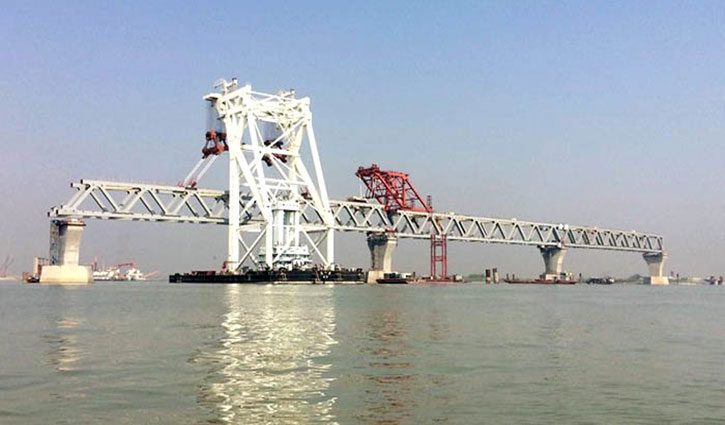
Staff Correspondent: After the installations of first and second span, the third span of the much-hyped Padma Bridge was installed between pillars 39 and 40 on Sunday.
The third span of the 6.15-km Padma bridge was installed at Jajira point of Shariatpur this morning.
With the installation of the third span, a total of 450 metres of the Padma Bridge is now visible, said Humayun Kabir, an assistant engineer tasked with the construction of the Padma Bridge.
Humayun Kabir said, “The third span has been installed within the scheduled time. Now the work to connect the two spans is underway. But it will take some time to complete. Pillar 41 is also being prepared to install the fourth span.”
The installation process of the 150 metres span has been started since morning. The floating crane carrying the 150-metre span weighing 3,140 tonnes reached near the pillars.
The first and second spans of the bridge were installed on September 30 last year, and January 28 this year.
In December 2015, Prime Minister Sheikh Hasina inaugurated the main works of Padma Bridge project, the biggest of its kind for the country, by unveiling its foundation plaque. It is expected to be completed by December next year.
When it comes into operation, the bridge will ease pressure on the country's premier seaport in Chittagong, 242 km southeast of capital Dhaka, as it will bolster the second largest Mongla seaport in Bagerhat district, 178 km southwest of the capital city, experts said.
In June 2014, the Bangladeshi government awarded China Major Bridge Engineering Company Limited a 1.55-billion-U.S.-dollar contract to build core structure of the Padma Bridge project which is to be completed in four years.
The 25-meter-wide and 10-km-long bridge will be built over Padma River, one of the three major rivers in Bangladesh.
About 6.15 km of the bridge is being built over the river while the remaining part on both banks.
The bridge will shorten the travel time between the capital and the southern city of Khulna from the current 13 hours to only about three hours.
The bridge is expected to promote trade and economy of Bangladesh, which, according to a World Bank report, has the potential to end extreme poverty by 2030.
risingbd/Dhaka/March 11, 2018/Asad/AI
risingbd.com