Suu Kyi urges people not to 'quarrel' on visit to Rakhine
5 || risingbd.com
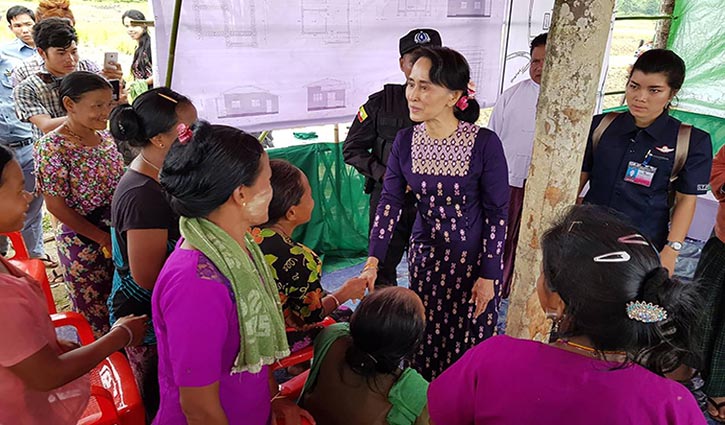
International Desk: Myanmar's de facto leader, Aung San Suu Kyi, has urged people "not to quarrel" as she visited Rakhine State for the first time since the military-led violence erupted in late August.
More than 600,000 Rohingya Muslims have fled the country to Bangladesh.
Ms Suu Kyi has faced heavy international criticism for not taking a higher profile in responding to what UN officials have called "ethnic cleansing" by the army.
Myanmar has rejected the accusations of ethnic cleansing, saying its security forces launched a counter-insurgency operation after Rohingya militants attacked security posts in northern Rakhine on August 25.
Amid heightened security, Ms Suu Kyi boarded a military helicopter at Sittwe, the capital of Rakhine State, to be taken to Maungdaw, one of the districts worst hit by the violence.
The Nobel laureate was accompanied by about 20 people travelling in two military helicopters, including military, police and state officials, a Reuters reporter said.
Ms Suu Kyi met a group of Muslim religious leaders, said Chris Lewa, of the Arakan Project monitoring group, citing Rohingya sources.
On Wednesday (local time), thousands of desperate Rohingyas were seen wading through shallows and narrow creeks between islands of the Naf river to reach neighbouring Bangladesh — evidence that the exodus begun two months ago was far from over.
Some had small boats or pulled makeshift rafts to get to Bangladesh on the river's western bank, but most walked, children cradled in their arms and the elderly carried on their backs, with sacks of belongings tied to staves on their shoulders.
Reaching the far side, some women and older people had to be pulled through the mud to reach dry land atop steep banks.
More than 4,000 crossed at different points on the river on Wednesday, Major Mohammed Iqbal, a Bangladesh security official in the southern district of Cox's Bazar, said.
Ms Suu Kyi had not previously visited Rakhine since assuming power last year following a landslide 2015 election victory.
The majority of residents in the northern part of the state, which includes Maungdaw, were Muslims until the recent crisis.
Ms Suu Kyi, who does not control the military, has lately appeared to take a stronger lead in the crisis, focusing Government efforts on rehabilitation and pledging to repatriate refugees.
She launched a project last month to help rehabilitation and resettlement in Rakhine and has urged tycoons to contribute.
Ms Suu Kyi has pledged to allow the return of refugees who can prove they were residents of Myanmar, but thousands of people have continued to flee to Bangladesh.
Talks with Bangladesh have yet to deliver a pact on a repatriation process made more complex because Myanmar has long denied citizenship to the Rohingya.
Ms Suu Kyi's spokesman voiced fears on Tuesday that Bangladesh could be stalling on the accord to first get millions of dollars of international aid money, an accusation a senior Bangladesh home ministry official described as outrageous.
The United Nations assistant high commissioner for refugee protection, Volker Turk appealed for the safe, voluntary and sustainable repatriation of Rohingyas.
In a statement issued on Thursday after a two-day visit to Myanmar, Mr Turk said he hoped the UNHCR would be involved in the Government's plans for voluntary repatriation.
But the scenes at the Naf river showed Rohingyas were still ready to risk being destitute in Bangladesh, rather than stay in Myanmar in fear for their lives.
Source: ABC Online
risingbd/Dhaka/Nov 2, 2017/Amirul
risingbd.com