US patience on North Korea ‘over’
3 || risingbd.com
International Desk: As he stood at the demilitarised zone dividing North and South Korea, US Vice-President Mike Pence warned Pyongyang that after years of taunting Washington and Seoul with its nuclear ambitions, “the era of strategic patience is over”.
At the start of his 10-day tour of Asia that will take him to Australia, Mr Pence visited the DMZ in a show of force that allowed the world’s second most powerful man to gaze at North Korean soldiers from afar and stare directly across the razor wire border.
The visit was personal for Mr Pence, whose father, Edward, was awarded a Bronze Star for bravery during the 1950-53 Korean War.
Former US ambassador Kim Beazley said the Australian government would press Mr Pence during talks on Saturday on how far the US would go on North Korea. A day after North Korean despot Kim Jong-un botched a medium-range missile test, Mr Pence said President Donald Trump was hopeful that China would use its “extraordinary levers” to pressure the North to abandon its nuclear program.
Pointing to the 25 years since the US first confronted the North over its attempts to build nuclear weapons, Mr Pence said a period of patience had followed.
“The era of strategic patience is over,” he said. “President Trump has made it clear that the patience of the US and our allies in this region has run out and we want to see change. We want to see North Korea abandon its reckless path of the development of nuclear weapons, and its continual use and testing of ballistic missiles is unacceptable.”
North Korea has conducted five nuclear tests, including two last year. Satellite imagery last week suggests the hermit state could conduct another underground nuclear test at any time.
Standing with Mr Pence back in Seoul, South Korean Acting President Hwang Kyo-ahn said the two allies had agreed on the early deployment in the region of the US missile defence system, Terminal High Altitude Area Defence, which can shoot down incoming missiles, and is strongly opposed by the North and its only ally, China.
With the carrier battle group USS Carl Vinson due off the Korean peninsula by Anzac Day, Mr Pence said the US commitment to its ally was “iron-clad and immutable” and any use of nuclear weapons by the North would be met with “an overwhelming, effective response”.
In Tokyo, Prime Minister Shinzo Abe said his government was drawing up contingency plans in case the crisis sent an influx of refugees to Japan. Mr Abe told a parliamentary session the government was formulating measures including protecting foreigners, landing procedures, building and operating shelters, and screening asylum-seekers.
Mr Abe urged China and Russia to apply pressure on North Korea “so they seriously respond to a dialogue”.
Mr Trump wrote early yesterday on Twitter that China was working with the US on “the North Korea problem” and National Security Adviser HR McMaster said Washington would rely on its allies as well as Chinese leadership to resolve the crisis.
Lieutenant General McMaster said there was a consensus with China that the “situation” could not continue.
He cited Mr Trump’s decision on April 6 to order missile strikes in Syria after a chemical attack conducted by the regime of Bashar al-Assad as a sign that the President “is clearly comfortable making tough decisions”.
The Trump administration is hoping China will help rein in North Korea in exchange for other considerations. Last week, Mr Trump said he would not declare China a currency manipulator, pulling back from a campaign promise, as he looked for help from Beijing.
“Why would I call China a currency manipulator when they are working with us on the North Korean problem? We will see what happens!” he tweeted.
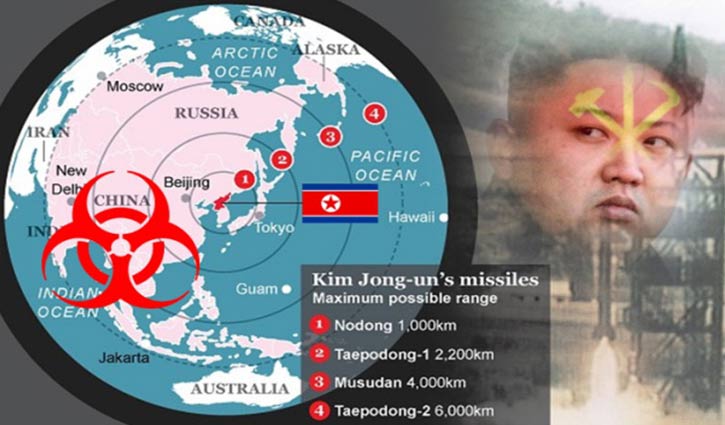
The White House said the medium-range missile that North Korea tried to fire on Sunday exploded about four to five seconds after it was launched. The North regularly launches short-range missiles, but is also developing mid-range and long-range missiles that could eventually hit the US west coast and Australia. The missile failure came after Kim marked the 105th anniversary of the birth of his grandfather, and the nation’s founding father, Kim Il-sung with a parade that included 60 missiles in Pyongyang.
Responding to speculation the launch failed as a result of a US cyberwarfare attack, a Pentagon spokeswoman said: “I am not aware of anything like this but we don’t discuss intelligence matters.’’
Mr Beazley said the possibility of the North developing a long-range nuclear missile would be at the top of the US agenda when Mr Pence meets with Malcolm Turnbull, Foreign Minister Julie Bishop and Bill Shorten in Sydney on Saturday.
“I would imagine the Australian government would really want quite detailed conversations.
“And about how they are getting on with China; that’s our main worry,” he said.
Source: theaustralian.com
risingbd/Dhaka/Apr 17, 2017/Nasim
risingbd.com