Taka 53,054cr for education in proposed budget
2 || risingbd.com
Desk Report: Finance Minister Abul Maal Abdul Muhith on Thursday proposed an allocation of Taka 53,054 crore for education in the national budget for 2018-19 fiscal.
He said, “We have already made significant progress in promoting primary education. Now we want to focus on providing education supportive of bringing about fundamental changes in living standard and to creating better learning environment at schools.”
“We believe that if a child starts growing up with the habit of following rules of personal hygiene and maintaining cleanliness of his surrounding, morality, discipline and responsibility, life skills and mutual
responsiveness, he can become an architect of building a happy and prosperous country,” the finance minister added.
He said the curriculum of primary education should be developed to accommodate these values and training to make it suitable for children.
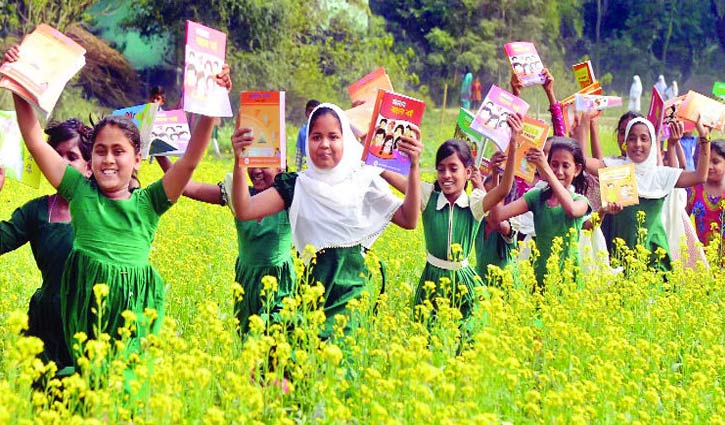
“To cope with the increasing demand, we will broaden the remit of ongoing programmes such as proving stipends, distribution of free textbooks and logistics, school feeding and so on,” he added.
In tandem with this, Muhith said, 7,000 primary schools with separate wash blocks for boys and girls to ensure better environment for education; 65,000 classrooms, 10,500 teachers’ rooms, boundary walls in 5,000 schools will be constructed and 30,000 pieces of sports-goods will be distributed.
“As follow up previous programmes, we will establish another 1,000 primary schools in areas without schools,” Muhith said adding, to ensure the provision of technology-based modern education system, ICT-based community learning centre will be set up in all unions and some selected towns.
“We have a plan to set up 64 livelihoods and lifelong learning centres in 64 districts. Aside from the ongoing training for teachers, we have taken steps to impart English language proficiency training through the British Council and eliminate the ‘math phobia’ by organising mathematics Olympiad for students,” the finance minister added.
Merit-based assessment at the secondary level, highest use of technology in education programmes, promotion of science education, and improvement in the quality of education are currently getting priority and will continue to receive such priority in future, Muhith added.
He said, We are creating admission opportunities for around 2,00,000 students in 200 government colleges through a project titled ‘Expansion of Opportunity for Science Education in Government Colleges’ and for around 3,29,000 students in 323 secondary schools through ‘Development of Government Secondary School’ project.”
Highlighting different ICT-based initiative, Muhith said classrooms with multimedia facilities, language cum ICT labs and hostels will be constructed and furniture and equipment will be supplied under these projects.
Moreover, construction of 46,340 multimedia classrooms and 2,120 smart classrooms has begun in 26,000 educational institutions at higher secondary, secondary and madrasa levels, he said.
Piloting of 23 innovative concepts is being carried out to provide education related services through low cost-time-visit approach, he said adding, “To ensure confidentiality in making question papers, we are trying to make a ‘Question Bank’ through integrated efforts of all education boards.
Muhith said, “I have already mentioned that around 2 million people are entering into labour market every year. However, all workers entering into labour market are not skilled. Therefore, we have to depend on skilled workers from neighbouring countries.”
On the other hand, he said, Bangladeshi labourers for their skill deficiency do not get reasonable wages abroad. “Thus flow of remittance is comparably low in proportion to the number of migrant workers. In fact, modern and forward looking madrasa education in the long run can play a catalytic role in gaining employment opportunities in Arab countries including Middle-East,” Muhith added.
Bearing this in mind, importance has been attached to the extension of employment-friendly technical and vocational education to generate interest in this kind of education while modernizing the madrasa education, he added.
While placing the budget in the Parliament, he said, “We have taken initiatives to set up one technical school and college in each of 100 upazila and technical training centres in remaining 389 upazilas.”
Alongside, technical and vocational education is popularised by developing infrastructures of the existing training centres, organising short training, teachers’ training and stipend programmes, he added.
Besides, steps have been made to establish four women polytechnic institutes in four divisional headquarters, one girls’ technical school in each divisional headquarters, polytechnic institutes in 23 districts and one engineering college in each administrative division, Muhith added.
“In order to modernise madrasa education, we have taken steps to establish 35 model madrasas and multimedia classrooms in 653 madrasas and introduce honours course in 52 madrasas,” he added. _BSS
risingbd/Dhaka/June 07, 2018/A K Azad
risingbd.com