Forcing a dialogue on interim government issue
A concerned citizen of Bangladesh || risingbd.com

Bangladesh has been passing through a critical political situation for more than a year and now has reached a volatile and dangerous stage. I would rather prefer to address the situation as volcanic considering the extreme stand taken by BNP on the Interim Government Issue, Bangladesh Jamaeti Islam on the annulment of the ongoing trial of their leaders at the ICT charged with crime against humanity during the war of liberation in 1971, Ganajagaran Moncho demanding highest punishment for the war criminals, Hefajate Islam with their 13 point demand and the uncertainty compounded by recent tragedy in the garments sector followed by labour unrest crippling the economy and social amity of the country. The single most important issue that put Bangladesh on a political volcano is the Interim Government issue as considered by the majority of the people and I tend to agree with them. Hundreds of deliberations, seminars, round tables and innumerable talk shows in TV media have since been conducted on this issue and appears to have been exhausted in failure in bringing the Government and the opposition in a dialogue to resolve the issue. In total agreement with the expressed opinion of the respected senior citizens and think tank of the civil society, professionals and legal experts, I strongly believe that with the settlement of Interim Govt. issue, the volatile political situation would calm down significantly and the major political parties and the people of the country would engage themselves in election campaign thereby bringing Bangladesh on it’s way to progress and prosperity.
Transparency International Bangladesh has come up with a sensible proposition outlining the process and model of an Interim/ Non Party Government which is regarded as a better solution amongst many such models so far recommended by distinguished citizens and organisations. The recommended framework of an interim Government by Barrister Rafiqul Hoq, Dr. Akbar Ali Khan and CPD also drew significant attention of the people and deserve admiration. Instantaneous appreciation of TIB’s recommendation by BNP has made it all the more important for the people to ponder on it.
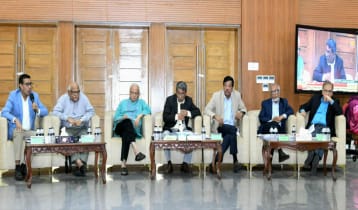
All humanly possible efforts and appeals of the civil society for a dialogue on Interim Govt. have distressfully failed to make either Awami League or BNP serious enough to sit for a dialogue. But that should not palliate the civil society of their moral responsibilities to salvage the country. They must not give up, they must continue their efforts and they can do it in an all together different way that I would like to suggest with an assurance of guaranteed success.
I propose that around 100 distinguished persons from the civil society comprising senior citizens, intellectuals, think tanks, businessmen, professionals, cultural activists, national professors, national heroes, freedom fighters, editors, journalists, student leaders, labour leaders, recognised bipartisan minded political leaders to rise above their self or organizational interest, ready to sacrifice their comforts for some time and have the conviction of serving the national interest alone doing the needful in winning the faith and confidence of the general people, assemble in a place and continue the assembly for an indefinite period till realisation of their demands. Sonargaon Hotel Auditorium could be a suitable venue of such an assembly where they heed to continue their programme from every morning till midnight and stay back at the hotel premises. All related expenses are likely to be borne by the business bodies since their business suffer most due to political unrest; TK 350 crore a day alone by Garments sector on one hartal.
The only agenda of that assembly would be to force the political parties to sit for dialogue and resolve all related issues that have pushed the country in a volcanic situation. On behalf of the general people of the country, they would invite concerned political parties and apolitical organisations for discussions and urge upon them to resolve their respective issues through dialogues. At the onset of their programme, they, on behalf the general people, would make an announcement at a roundtable meeting carrying a distinct message that their assembly would continue till the major political parties sit for a dialogue and resolve the interim govt. issue vis-a vis other related issues responsible for the ongoing
political crisis.
I believe, or rather, am fully confident, that such an appeal by the civil society, with a likely strong media support would draw instant attention of the general people, professionals, business bodies and social organisations from all over the country and they would extend their solidarity with the assembly spontaneously from their respective position/platform without being essentially making their presence at the assembly. The appeal is likely to turn into a demand of the general people soon that is announced and that would offer a dignified way out for Awami Leage and BNP to leave their respective stubborn unrealistic stand and sit for a positive dialogue. The civil society attending the assembly comprising the best and most knowledgeable people from all sections of the society, may also workout and offer suitable options of solution and mediate the dialogue as well.
A convening committee comprising members from TIB, CPD and SUJAN may fast be formed to initiate, organise and coordinate the said assembly. I also have thought of a solution that assures a free, fair and credible election under the ruling Govt. and humbly wish to put forward for the consideration of the concerned political parties:
That prior to nine months of the completion of the tenure of the sitting Government, the speaker would form a parliamentary committee consisting of ten members of the parliament. Five members of the said committee would be selected by the leader of the house and five members by the leader of the opposition. The said committee, within a period of one month would select a five member’s election commission including a chief election commissioner on consensus basis. Failing to reach to a consensus on the selection of a chief election commissioner/ election commissioners, the committee must propose a maximum of two names for the position of chief election commissioner and a maximum of two names for the position of each election commissioner and submits the proposal to the speaker. The speaker, if the proposal is a consensus one consisting of one chief election commissioner and four election commissioners, would directly forward it to the President for their appointments within seven days. Prior to the appointments of the new election commission, all the existing election commissioners including the chief election commissioner would resign on the request of the President.
That on the occasion the parliamentary committee submits more than one name for the position of chief election commissioner or commissioners, the speaker would refer such proposal to the appellate division of the Supreme Court or to a seven members committee comprising of willing and senior most former justices of the appellate division of the Supreme Court. The full bench of the appellate division of the Supreme Court or the said seven members committee would select one name from the proposed two names for the position of chief election commissioner and one name from the proposed two names for the position of election commissioner/commissioners as the case may be within a period of fifteen days from receiving such proposal from the speaker and send that back to him. The speaker then forwards the final list of one chief election commissioner and four election commissioners to the President for their appointments.
The new election commission would assume their office within three days from the date of their appointments by taking oath of their respective office.
That prior to six months from the date of completion of the tenure of the parliament, the total authority related to the transfer and posting of all government officials shall be vested on to the election commission.
On disillusion of the parliament, the existing government, on the request of the President would continue as an interim government and its role would be restricted only to look after the day to day affairs of the country similar to a Caretaker Government we have had earlier. All decisions related to national election made by the election commission including working out the budget for conducting the election, deployment of Armed Forces with term of reference during the period of election would be final and mandatory for the concerned ministry/authority. Operations of BTV, Bangladesh Betar and all Government Medias shall come under the control of the election commission.
The code of conduct formulated by the election commission which may even be based on an MOU signed between the parties in the dialogue must ensure that the Prime Minister, Ministers and government officials can in no way influence the process of election and shall have the authority to summon any person including the Prime Minister if the commission is in the opinion that the said person has violated the code of conduct and take actions as it deems necessary.
The above brief proposal, subject to its acceptance by the concerned parties, needs to be worked out further through dialogue such as what would be the modalities of its implementation in case of early disillusion of the parliament and whether it would require any amendment to the constitution to implement the proposal or enactment of a law in parliament suffice the purpose. I strongly believe that adoption of above proposal would greatly contribute in institutionalising democracy in Bangladesh and the system would go well with the recognized, tested and successful process of holding elections in all the democratic countries of the world.
Finally, may I express my deepest appreciation to all the political parties for their sincere passion for democracy, parliamentary system of Government and the recognition that all power lies with general people of the country. And that indeed gives rise to my long cherished desire to see all the political parties, during the process of dialogue, come to a consensus understanding constitutional amendment to in annulling Article 70 and bringing it down to 15 days instead of 90 days continuous absence in the parliamentary session to lose their seats in parliament.
A concerned citizen of Bangladesh
risingbd.com