Lives adrift: Climate adaptation in Gaibandha’s river eroded char
Easmin Akter || risingbd.com
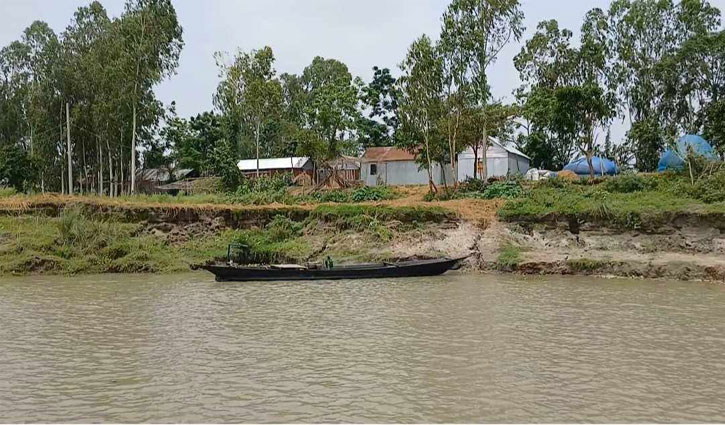
The people here have struggled to survive during the floods.
On the windswept banks of the Teesta River in northern Bangladesh, the people of Porar Char (a river island) know all too well the price of living on the edge of a disappearing land. Every monsoon season, floodwaters rise and riverbanks crumble, claiming homes, crops, and memories. Yet, amidst the chaos of displacement, the residents are rewriting their story—with resilience, innovation, and a fierce will to adapt.
For decades, Porar Char—a remote river island in Gaibandha district—has faced repeated displacement due to river erosion and flash floods, two growing threats exacerbated by climate change. But the tide is slowly turning, as locals embrace community-driven climate adaptation strategies to protect their lives and livelihoods.
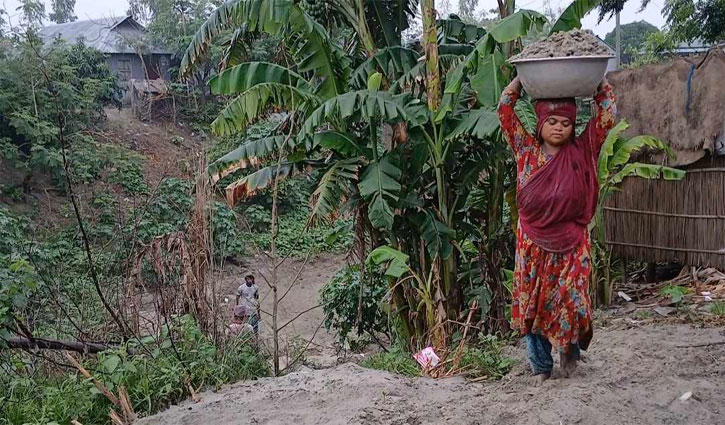
To save their home from being submerged in the flood, they are building an oval-shaped structure.
‘We’ve lost our home three times to the river,’ said Shahinur Rahman, a 45-year-old farmer. ‘But now we are trying to farm differently, grow crops that survive floods, and build homes that the river cannot wash away so easily.’
Farmers like Shahinur have started cultivating flood-tolerant varieties of rice and vegetables with support from NGOs. These crops survive longer in waterlogged conditions, ensuring food security even during severe flooding. ‘The yields are smaller, but at least we don’t lose everything anymore,’ he added.
One of the most striking signs of adaptation in Porar Char is a new style of housing—climate-resilient, oval-shaped homes. Raised above flood level and built around a central pond that collects excess water, these structures are designed to stay habitable even during inundation. The design, promoted by a local NGO, uses locally sourced materials and combines traditional wisdom with modern resilience.
Women, too, are playing a vital role in adaptation. Fatema Begum, 34, has become a successful poultry entrepreneur after attending training sessions organized by a non-profit. ‘When the river takes our land, it doesn’t take our skills,’ she said with a quiet smile. ‘Now I earn enough to send my children to school.’
Education and healthcare access have become integral parts of the adaptation process. Makeshift schools on raised platforms keep children learning even during floods, while mobile clinics supported by development agencies bring basic healthcare to the char's isolated residents.
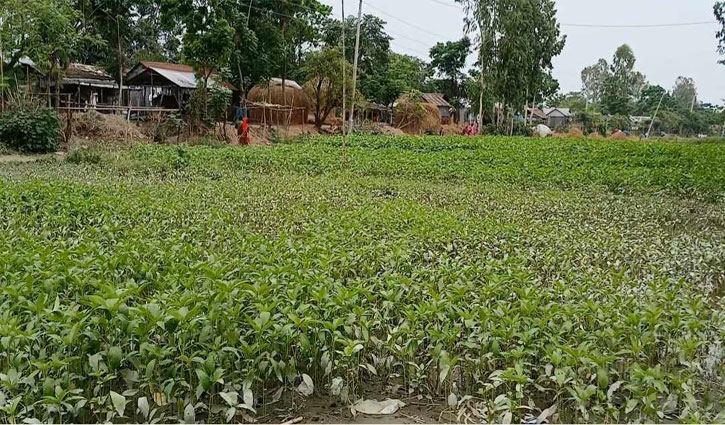
These water-tolerant crops help ensure food security for communities during severe flooding.
Mohammad Idris, a field officer with a local NGO, said community engagement has been key. ‘We don’t just offer solutions—we listen,’ he said. ‘Every village has different challenges. Some need embankments; others need alternative income sources. Adaptation must be local.’
Yet challenges remain. Infrastructure is fragile, resources are limited, and future floods may still bring disaster. But for now, Porar Char stands as a testament to human determination in the face of climate uncertainty.
‘We can’t fight the river,’ Fatema said. ‘But we can learn to live with it.’
Dhaka/AI