Learning against the current: The struggles of char children in Gaibandha
Easmin Akter || risingbd.com
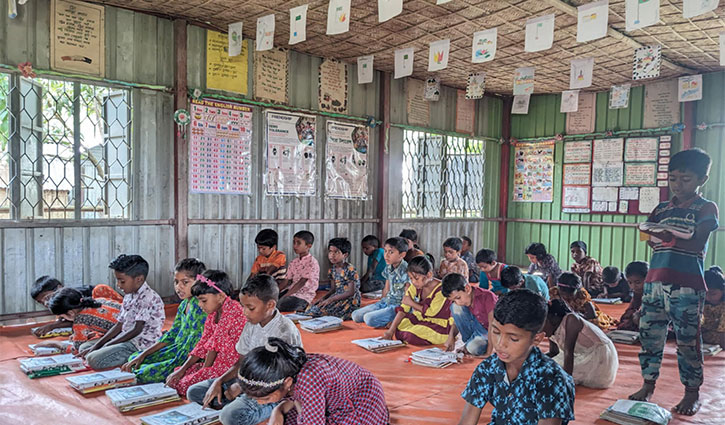
Char children’s education is not just survival — it’s a courageous fight to live with dignity.
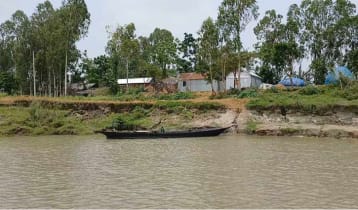
Every morning at dawn, 10-year-old Asiya steps into a narrow wooden boat with her younger brother to begin a perilous journey to school across the Brahmaputra River. Their village, Char Batikamari belonging to Gaibandha district, lies on one of Bangladesh’s many low-lying river islands—known locally as chars—where education is a daily struggle against nature.
“We pack our books and leave before sunrise. My mother says we must study, even if it’s hard,” Asiya says, clutching her bamboo school bag.
In Char Batikamari, access to education has become increasingly difficult as climate change intensifies flooding and river erosion. With schools washing away and transportation becoming dangerous, thousands of children across Bangladesh’s chars face a growing risk of being left behind.
Erosion Worsens with Climate Change
River erosion is a constant reality in the Brahmaputra basin, but climate-induced changes have made it more severe and unpredictable. In recent years, the local government primary school in Batikamari was completely lost to the river.
With no permanent building remaining, children now study in makeshift bamboo and tin structures. These are easily damaged by storms and heavy rains, and are often rendered unusable during the monsoon.
“There was a school building here once,” says Rowshan Ara Begum, a local resident. “Now the children study under trees or in open fields. If it rains, there are no classes.”
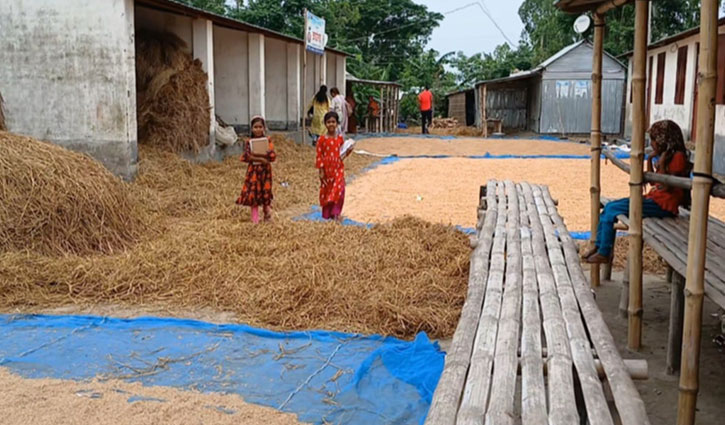 Going to school is a major challenge for char children.
Dangerous Commutes and Delayed Dreams
The challenges don’t end at infrastructure. During the rainy season, large parts of the char are submerged. With no roads, boats are the only way to reach school—but they are often unsafe and scarce.
“If we miss the morning boat, we miss school,” says Rabby, a sixth-grade student. “Sometimes the water is so high that we’re afraid the boat will flip. Still, I go. If I don’t, I can’t sit for my exams.”
Md. Mosaddikur Rahman, a field officer with the NGO Friendship, which runs education projects in the region, notes: “Despite extreme adversity, char children show remarkable determination to continue learning. We’re trying to ensure no child is excluded due to their geographical position.”
Examinations Under Threat
High-stakes national exams bring even greater challenges. Runa, an SSC (Secondary School Certificate) candidate, was on her way to an exam center during last year’s monsoon when her boat capsized in a sudden storm.
“I swam ashore, but I missed the exam,” she says. “My mother cried. I kept saying, ‘If I don’t take this exam, I won’t be able to keep studying.’”
Such incidents are not uncommon. For many char students, each exam feels like a life-or-death moment.
Teachers on the Front Line
Teachers in these remote areas also face severe difficulties. Many live in the chars themselves and must endure the same dangerous travel conditions as their students. Inadequate facilities—including the lack of science labs, libraries, and basic furniture—further compound the challenge.
“We come to class no matter what, because we know education is the only hope these children have,” says Md. Rafiqul Islam, a local schoolteacher.
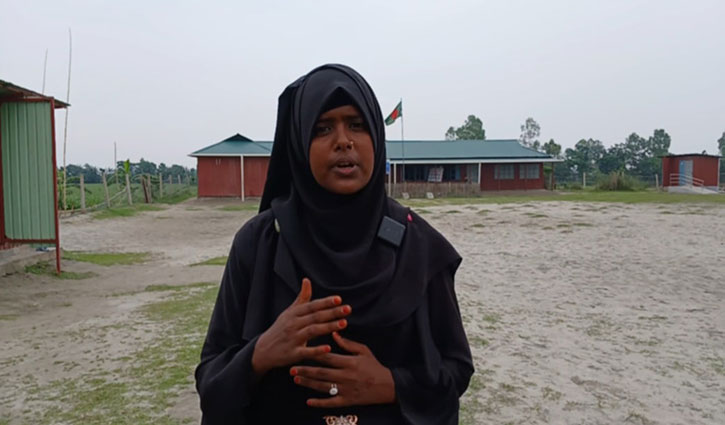 Ninth-grade student Tanzina Akter was sharing a story of moving forward.
Calls for Government Intervention
Local leaders and communities have long called for stronger government support. Requests have been made for permanent school buildings, teacher housing, and dedicated boat transport for students.
“We’ve informed the district administration,” says Union Chairman Rezaul Islam. “We’re still waiting for a response.”
A Fight for the Future
Despite the barriers, hope remains. Many students continue to dream of better lives. Tanzina Akter, a ninth-grade student, says: “I want a proper school here, so my younger siblings don’t have to suffer like I did.”
The struggle faced by children in the chars underscores a broader challenge: while Bangladesh participates in international climate summits, many of its most vulnerable citizens are already living the consequences.
For the children of Char Batikamari, the right to education is not just a policy issue—it is a daily battle for dignity and survival. As the country champions climate action on the global stage, campaigners say it must also deliver real solutions at home.
Dhaka/Eva/AI