Women`s empowerment in Bangladesh: A secret of progress
Augustin Sujan || risingbd.com
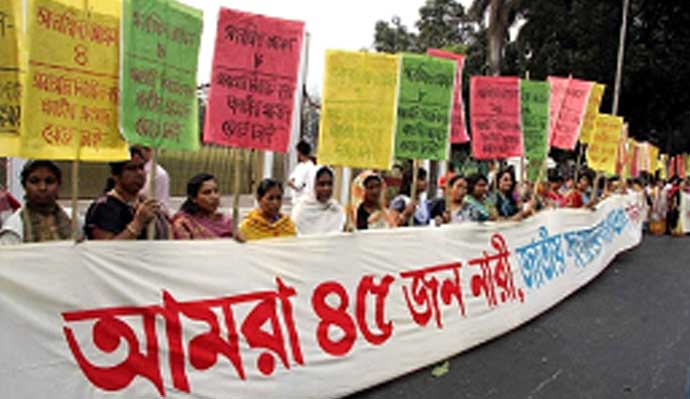
Women in Bangladesh now hope for even greater representation in the future
Debasish Das, from UK: Bangladesh, with half of the total population women, is a developing country, whose socio-economic condition is very low. No socio-economic, political and cultural development is possible without the empowerment of women.
Bangladesh is a very important county not only in Asia but also in the globe. Why Bangladesh is so attractive to the world media day to day and showing interest all the development countries. If we look at the world economic condition the answer will be easy. In 2008 when the world economy turned down (recession), all the development countries faced problem and challenges. Everyone wants to survive from the recession. But what is the way?
Bangladesh is a country which was less affected by that situation. But what is the secret power of Bangladesh behind this success. The secret power is the recent women empowerment which is leading and helping to raise the economy of Bangladesh.
The women of Bangladesh are no more only house wife and insider worker. They came out from the home and took the challenges to change the economy, politics, and social culture in Bangladesh very rapidly. These activate draw attention of developed countries towards Bangladesh. Bangladesh is a role model of women empowerment and development in the world map. Bangladesh faces big challenges in religious and cultural aspects but the powerful and dedicated women took the challenges and overcome all barriers for their success.
Recently, we saw, prime minister of Bangladesh received 828 applications for 38 women reserved seats for the 10th parliamentary election. So we can understand the progress, interest and awareness of women in politics in Bangladesh. Therefore, we cannot say now women are sitting only in home but they came out for power and politics and leadership role in Bangladesh. This is another form of successful women empowerment in Bangladesh.
So what is the main definition of women empowerment?
Empowerment of women is such a process which controlling women rights, challenges gender disparity in parental and social institutions.
The socio-economic condition refers to the social dignity, educational qualifications, family marriage system, mother, social value, occupation salary, wealth etc.
The Bangladeshi women have made massive gains since the country achieved its independence in 1971. The past four decades have seen increased political empowerment for women, better job prospects, improved education and the adoption of new laws to protect their rights. As of 2013, the Prime Minister of Bangladesh, the Speaker of Parliament, the Leader of the Opposition and the Foreign minister were women. However, issues like domestic violence, acid burning and rape still is a major problem in the backward society in Bangladesh. But the government and other activist are trying to reduce this problem in different ways. The awareness is increased than before. Hope these problems will be solved very soon and we will see nobody will through acid or create violence as they did before.
Most women`s lives remained cantered on their traditional roles, and they had limited access to markets, productive services, education, healthcare, and local government. This lack of opportunities contributed to high fertility patterns, which diminished family well-being, contributed to the malnourishment and generally poor health of children, and frustrated educational and other national development goals. In fact, acute poverty at the margin appeared to be hitting hardest at women. As long as women`s access to health care, education, and training remained limited, prospects for improved productivity among the female population remained poor. But the present government has taken massive steps to move forward the women and this will help the women to establish their right in Bangladesh very soon. Hope we will see a big change within the short period in Bangladesh.
The devaluation of women labour in labour market also hinders women right. The things should consider for the development of women empowerment in Bangladesh are as below:
• To understand the importance about the role of women in the development of the society.
• What are the obstacles and the causes of obstacles.
• To know about the obstacles women face in the field of work.
• To know social attitude towards women independence.
• The dignity of women, the role of women in the field of socio-economic and political development and many other problems of women should need to specially consider sharing the empowerment in total population of Bangladesh.
The socio-economic Condition of Women is very much related to women empowerment in Bangladesh. But if we think in-depth the present condition of women in Bangladesh what is the scenario is? Most of the women in Bangladesh consider in erotic social value and superstition. In this condition women are always dependent relatively on men.
From the early childhood female child is neglected. The birth of male child is welcome on the other hand that of female child is considered as a curse. When the female child is growing up, she realize that she is born to serve the female, she is a curse for the society or family and the social environment enhances her idea and for this men use social superstition, religious sentiment, ignorance’s and weakness and helplessness of women.
There is another cause behind the less empowerment of women in Bangladesh that is women age, marriage system, relationship and motherhood. The right of women in the case of marriage is negative. The father becomes the final decision maker and mother’s decision is always neglected. So it looks like men dominated society where is women always neglected. The registry, demand of bride, witness etc are compulsory. If the marriage is not registered, it is illegal. Since there are double rules in the society, the women can’t take action when they are divorced.
As a result they are very helpless due to faulty law. Law need to be changed in fever of women thus they can establish their right quickly in justice system of Bangladesh which will help them to fight against the one side rules. The agreement in marriage in Islam is equal but in practical, it is quit different. The men have the right to divorce; keep four wives at a time. Here women are inferior to men. In the other hand in Hindu community have not any legal documents only the commitment. But the good news is that present government took the initiative for documentation of Hindu marriage in Bangladesh, I believe this new law will help the Hindu women to protect their right against any discrimination.
UNDP focuses on gender equality and women’s empowerment not only as human rights, but also because they are a pathway to achieving the Millennium Development Goals and sustainable development. So what is UNDP goal: UNDP coordinates global and national efforts to integrate gender equality and women’s empowerment into poverty reduction, democratic governance, crisis prevention and recovery, and environment and sustainable development. Through our global network, we work to ensure that women have a real voice in all governance institutions, from the judiciary to the civil service, as well as in the private sector and civil society, so they can participate equally with men in public dialogue and decision-making and influence the decisions that will determine the future of their families and countries.
If we look at the research side in Bangladesh, we will see recent studies also show that women face more barriers in the workplace than men do. Gender-related barriers involve sexual harassment; unfair hiring practices, career progression, and unequal pay where women are paid less than men are for performing the same duty. Such barriers make it difficult for women to advance in their workplace or receive fair compensation for the work they provide.
Empowerment in international development
The UK`s Department for International Development are working to address constraints to the empowerment of adolescent girls in developing countries. Researchers mapped organisations that competitively seek innovative ideas from both the private and non-profit sectors potentially to reach girls, youth or women in developing country contexts and provides support in the forms of finance and technical assistance to bring their ideas to market.
In 2008, Africa began the Initiative for the Economic Empowerment of Women Entrepreneurs Project (IEEWEP) with funding by ExxonMobil. The goal of the project was to increase women’s income and participation in local business in Southern Chad. In a society that relies heavily on agriculture, IEEWEP streamlined the way women farmed and took their goods to market by training them on better agricultural practices and opening two new agro-processing centres. In the past three years, more than 1,000 women have worked through a graduated business development project, which has diversified their income sources and increased their annual income by approximately 70%.
What Is Successful Empowerment?
The idea of women’s empowerment is not clearly defined. For example, organizations should ask themselves when they start employment initiatives whether they are addressing working in the house or out of the house, in the formal sector or the informal sector, Wendy Baldwin, President and CEO of US based NGO Population Reference Bureau, said. “What is it about having that job or that income that makes a difference when [women] come home?” For organizations making these decisions, “it would be extra helpful to actually understand how these concepts knit together so that you would have half a chance that pushing on this part of the concept is actually going to give you the effect at the other end that you want,” she said.
In Alaka Basu, Senior Fellow, Women and Population, United Nations Foundation, thinks, empowerment is best defined as an expansion of agency throughout women’s lives, not in individual sectors. “We mean expansion of choice according to [women’s] rules,” she said. “Even ‘bad’ behaviors can be an outcome of expanded choice.”
Baldwin applauded Basu’s message about expanding the traditional approach to empowerment, urging organizations to “unpack the concepts” behind their goals to determine what they define as successful empowerment.
WOMEN AND POLITICS - ONE STEP AHEAD IN WOMEN EMPOWEMENT IN BANGLADESH
A global report has ranked Bangladesh 8th in terms of women’s political empowerment. A foreign office statement said, “Bangladesh was praised at the meeting for enhancing its women labor force from 24 percent (2010) to 36 percent in 2013 and significant representation of women at highest political levels.”
“Bangladesh, according to Global Gender Gap Report 2012, has been ranked 8th in the world in terms of political empowerment of women owing to women-centric policies of the present government”, former Bangladesh Foreign Minister Dipu Moni told a conference on "Equal Futures Partnership" hosted by US secretary of state John Kerry last year. Earlier she attended a round table jointly organized by the Netherlands and Bangladesh on “Working Together to Improve Working Conditions in the RMG Sector in Bangladesh.”
Following discussions DG, ILO and Government of Netherlands, Canada and the UK signed an agreement to finance the ILO project on support to Bangladesh’s RMG industries to improve safety and welfare of labor. Which is directly support to women in Bangladesh? Basically this support helps to establish women empowerment in Bangladesh.
Elected Women’s Members to the Bangladesh Parliament (1973-2001)
Year % of female candidates Won Total elected Reserved Seats in parliament (%)
1973 0.3 0 0 15 4.8 (out of 315)
1979 0.9 2 2 30 9.69 (out of 330)
1986 1.3 5+2 7 30 11.21 (out of 330)
1988 0.7 4 4 0 1.33 (out of 300)
1991 1.5 8 +1 9 30 11.81 (out of 330)
1996 1.36 13+2 15 30 13.03 (out of 330)
2001 1.79 6 6 0 2.00
Source: Election Commission of Bangladesh.
In 1996, Prime Minister Sheikh Hasina inducted three women leaders in her 42-member cabinet including herself. Other women cabinet ministers included Matia Chowdhury (Minister for Agriculture) and Sajeda Chowdhury (Minister for Environment and Forest). Women cabinet members did not increase afterwards.
Women in National Parliaments in Selected countries.
Rank Country Elections % of women
1 Rwanda 2003 48.8
2 Sweden 2002 45.3
3 Norway 2001 38.2
23 Australia 2004 24.7
49 UK 2001 18.1
59 USA 2004 15.0
93 India 2004 8.3
98 Japan 2003 7.1
122 Bangladesh 2001 2.0
Source: Inter Parliamentary Union, Women in National Parliaments, (as of February 28, 2005).
Sheikh Hasina lost in the 2001 parliamentary elections and Khaleda Zia was again elected as the prime minister for the second time. The then BNP-led coalition government of Khaleda Zia has also included three women cabinet ministers (excluding herself) in the unprecedented 62-member large cabinet. These women are Khurshid Jahan Huq (Minister for Women and Children Affairs), Begum Selima Rahman (Minister for Cultural Affairs), and Jahanara Begum (Adviser for Primary and Mass Education). It is apparent that women ministers are assigned somewhat ‘soft’ ministries perceived by the aspirant political leaders. The same politically and financially influential men belonging to large political parties have always dominated government and politics and occupied more significant ministries.
We can see from the above table and statistics that in 1996, the Bangladesh Parliament had the highest representation of women (13.03) including the reserved seats. However, both in the 1988 and 2001 Parliaments, the provision for 30 reserved seats for women were not maintained, which resulted in fewer women represented in the Parliament. In respect of the reservation of seats for women, the debate continues. The Election Commission of Bangladesh observed that ‘whether the present system of reservation of 30 seats for women in the parliament should be continued in its present form or in some other suitable system should be reviewed. Women leaders demand that there should be at least 100 seats in the national parliament where women representatives would be elected by the direct voting of the electorate.
Elected Women Chairpersons to the Union Parishad of Bangladesh (1973-2003)
Year Total Union Parishad Female Candidates Elected Female Candidates
1973 4,352 Not available 1
1977 4,352 Not available 4
1984 4,440 Not available 4
1988 4,440 79 1
1992 4,443 115 15
2001 4, 443 102 20
2003 4,443 232 22
Source: Election Commission of Bangladesh, Women in Bangladesh, Bangladesh National Report, 1995.p. 9
Women Are Gaining Independence soon in Bangladesh
Most women live in very poor conditions. Although wages in the garment sector are comparable to wages in the rest of the economy, the constant stream of garment workers from the countryside to the cities of Dhaka and Chittagong has made affordable housing a critical problem. It is not unusual for workers to pay over half their salary for a few square meters in which to sleep and eat. And it is also not unusual for landlords to raise the rent as soon as a garment worker gets a salary increase.
Rankings
According to the UN Development Programme`s Human Development Report for 2006, Bangladesh ranks 137 out of 177 countries on its Gender Development Index; and 67 out of 75 on the Gender Empowerment Measure, a measure of gender inequality in economic and political terms.
The Global Gender Gap Index 2007 ranks Bangladesh 100 out of 128 countries in terms of gender equality.
Conclusions
Despite the fact that women’s development has been accorded priority by different governments in the consecutive Five-Year Plans of Bangladesh, women continue to be disadvantaged, deprived, neglected, and face discrimination even after 42 years of independence. The society is male-dominated while women are poverty-stricken and continue to be victims of domestic violence and abandonment. In spite of constitutional guarantees, women have not enjoyed the same equal rights as men as accorded to them. At the onset of the new millennium, the percentage of female representation at both the local and national level has remained low compared to global standards.
We hope the people of Bangladesh and their mindset will be changed very soon in connection with global context and they try to more respect women and give them always priority to take part in all level of development in Bangladesh. Please remember without participation of women Bangladesh never be a Sonar Bangladesh. So please support the women all the way to establish women empowerment in Bangladesh.
Debasish Das, MA, MBA (UK): Author of a Tourism book - “Bangladesh –E- Parjatan Akarshon”, freelance writer, worked in a Renown University in UK at present Working in Facilities and crime Prevention Unit in Public Sector in UK.
risingbd/Augustin Sujan
risingbd.com